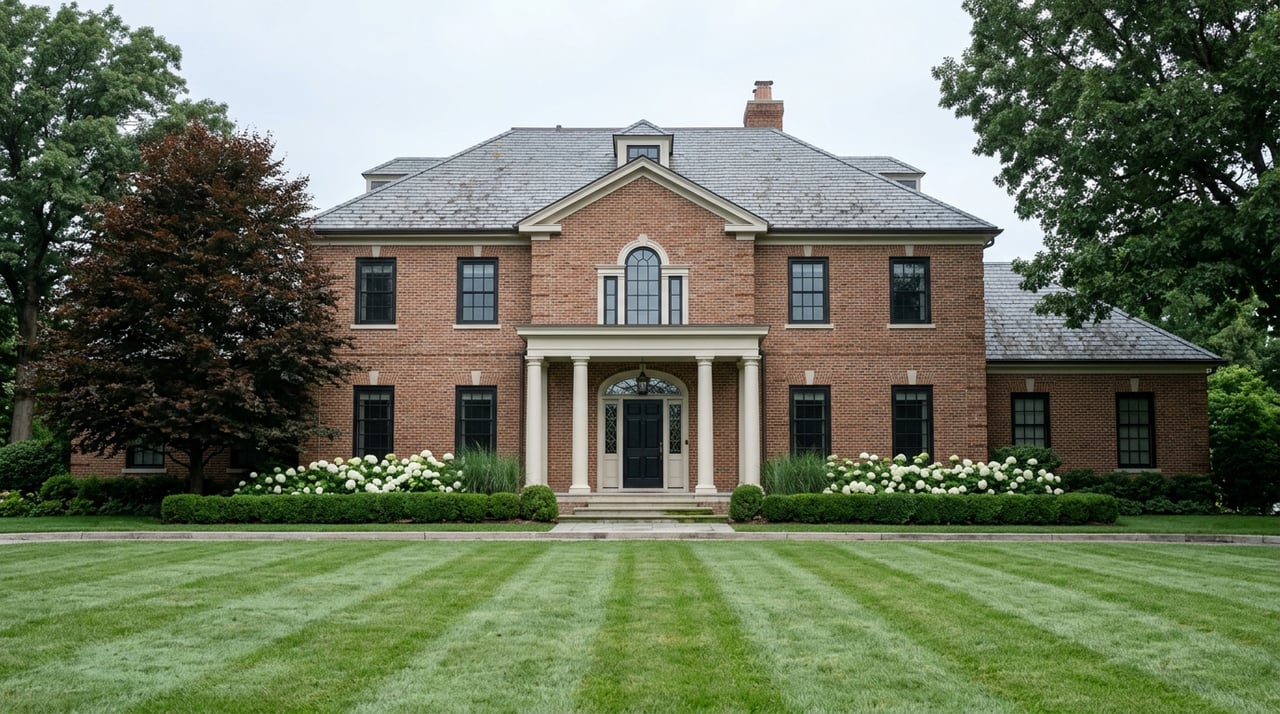
Drive south on Telegraph past Maple Road these days and something is different, even if you can't immediately place what. The white pillars are back. Ten of them, standing along the veranda that faces the South Course, visible the way they've been visible to anyone who's made that drive for the last hundred years. For four years, that view was a construction fence and a tented pavilion. Now it's pillars again.
What most people driving past don't know is that almost nothing behind those pillars is the same building. Oakland Hills Country Club spent more than $100 million to make sure you wouldn't notice.
Four Years Under a Tent
As The Detroit News reported, a fire tore through the clubhouse for hours on February 17, 2022, before firefighters brought it under control. The cause, according to the Bloomfield Township Fire Department, was a propane torch being used by construction workers on a patio project. By the time it was out, the 90,000-square-foot building that had opened in 1922 was a total loss. Members and volunteers managed to save a portion of the memorabilia before the flames reached it, but the structure itself, the marble, the mahogany, the green wallpaper generations of members had walked past, was gone.
What followed was four years of the club operating without the thing that had defined it. A large four-season pavilion went up to handle dining and functions. The pro shop moved into the First Tee Building, which had previously just stored clubs. The administrative staff worked out of a house the membership purchased near the third hole. There was no permanent locker room. No dining room. No lounge.
The club didn't cancel anything during that stretch. It hosted the 2024 U.S. Junior Amateur entirely out of the tented pavilion, with 264 competitors playing while the club's actual home sat as a construction site next door. Trevor Gutschewski won that tournament. His shadow box now hangs in the hallway off the main foyer of the new clubhouse, the newest thing in a room otherwise built to look decades old.
A $100 Million Illusion of Sameness
Here's the part that's easy to miss if you only see the finished building. Oakland Hills didn't rebuild bigger, flashier, or more modern-looking. It spent enormous money to engineer a replica, which reopened about four years after the fire.
The new clubhouse sits on the same footprint as the original, behind the same first and tenth tees, the same ninth and eighteenth greens. The ten pillars, each standing roughly 30 feet tall, were rebuilt to match the originals almost exactly. Inside, the marble and mahogany are back, along with the traditional green wallpaper members remembered from before the fire. Even some of the memorabilia display cases, 37 of them, hold artifacts from Arnold Palmer, Gary Player, and Jack Nicklaus that survived the blaze.
What changed is everything you can't see from the driveway. The building grew from 90,000 to 110,000 square feet, about 22 percent larger, to accommodate modern HVAC systems, three kitchens, expanded locker rooms, and event infrastructure the 1922 structure was never built to hold. Club leadership has branded the whole effort "The Next 100 Project," a phrase that captures the tension at the center of it: honor the past exactly, while quietly building for a different scale of operation entirely.
| Detail | Original clubhouse (1922) | Rebuilt clubhouse (2026) |
|---|---|---|
| Square footage | 90,000 | 110,000 |
| Veranda pillars | 10, roughly 30 feet tall | Same 10, rebuilt to match |
| Site footprint | Behind 18th green, 1st and 10th tees | Identical footprint |
| Major championships hosted before | 6 U.S. Opens, 3 PGA Championships, 2 U.S. Amateurs, 1 Ryder Cup | 2029 U.S. Women's Amateur, 2031 & 2042 U.S. Women's Opens, 2034 & 2051 U.S. Opens, 2038 U.S. Girls' Junior, 2047 U.S. Amateur |
If a landmark's job in a neighborhood like this is to look permanent, Oakland Hills just paid a nine-figure sum to prove it takes that job seriously.
The Rebuild's Pace, Funding, and Cost
The speed is the part worth sitting with. A 110,000-square-foot building with this much history behind it, rebuilt to this level of detail, in a little over two years of active construction, is fast for a project of this scope. Ground broke in December 2023, following an extensive design and permit process. Just six and a half months later, on July 9, 2024, the membership held a topping-out ceremony as the final steel beam went into place. Construction ran through spring 2026, when members were welcomed back for a three-seating Easter Sunday brunch on April 5, followed by a formal media unveiling on April 28.
The rebuild was paid for through a mix of insurance proceeds and member assessments, with hundreds of members approving individual assessments running into the thousands of dollars each. The initial project estimate was pegged at $96.5 million. By the time it opened, the final cost had climbed past $100 million, well above the roughly $80 million originally budgeted.
In an account published by the USGA, club general manager Matt Dossey said:
"The enthusiasm of the staff and membership about this project is extraordinary."
He added that the club was glad to welcome back the local, national, and international friends who had helped along the way. PGA emeritus professional Steve Brady described the reopened veranda and the view down the South Course as one of the finest settings for golf anywhere in the world.
What This Means for the Next 25 Years
Oakland Hills is a private club. Most residents of Bloomfield Township will never set foot past that veranda, and this isn't an argument that they should try. But the building itself is now a fixture of the view along this stretch of Telegraph in a way that goes beyond membership rolls. The South Course currently ranks 20th nationally and second in Michigan on Golf Digest's latest rankings, trailing only Crystal Downs in Frankfort. The club has already locked in a tournament calendar that runs through 2051: the U.S. Women's Amateur in 2029, U.S. Women's Opens in 2031 and 2042, the U.S. Girls' Junior in 2038, a U.S. Open in 2034, another in 2051, and a U.S. Amateur in 2047.
That means the next quarter century of national golf coverage, camera crews, and championship traffic on this stretch of Bloomfield Township is already scheduled. Whatever else changes in the neighborhood between now and 2051, this address will keep showing up in golf history, as it has since 1918, when Donald Ross first laid out the South Course.
We've written before about how this part of the township treats its institutions, from the phased, multi-year closure of the Bloomfield Township library to the everyday rhythms of life on this side of Oakland County. Oakland Hills is the most expensive version of the same instinct: when something here burns down or wears out, the response isn't to build something new and call it progress. It's to spend whatever it takes to bring back exactly what was lost, then quietly modernize everything nobody can see.
If you're already living in Bloomfield Township, you don't need us to tell you the neighborhood is changing in a dozen small ways at once, a library rebuilding in phases, a landmark clubhouse rising from ash on the same footprint it's held for over a century. If you're watching this stretch of Oakland County from a distance and wondering what it actually feels like to live somewhere that treats its landmarks this way, that's a conversation worth having directly.
Moving MI, led by third-generation Michigan broker Paul Wolfert, tracks these neighborhoods the way a resident does, not the way a database does. If you're weighing a move into Bloomfield Township or want a clear-eyed read on what your current home is worth in this market, reach out for a free home valuation and a customized marketing plan built around the neighborhood you're actually in.
