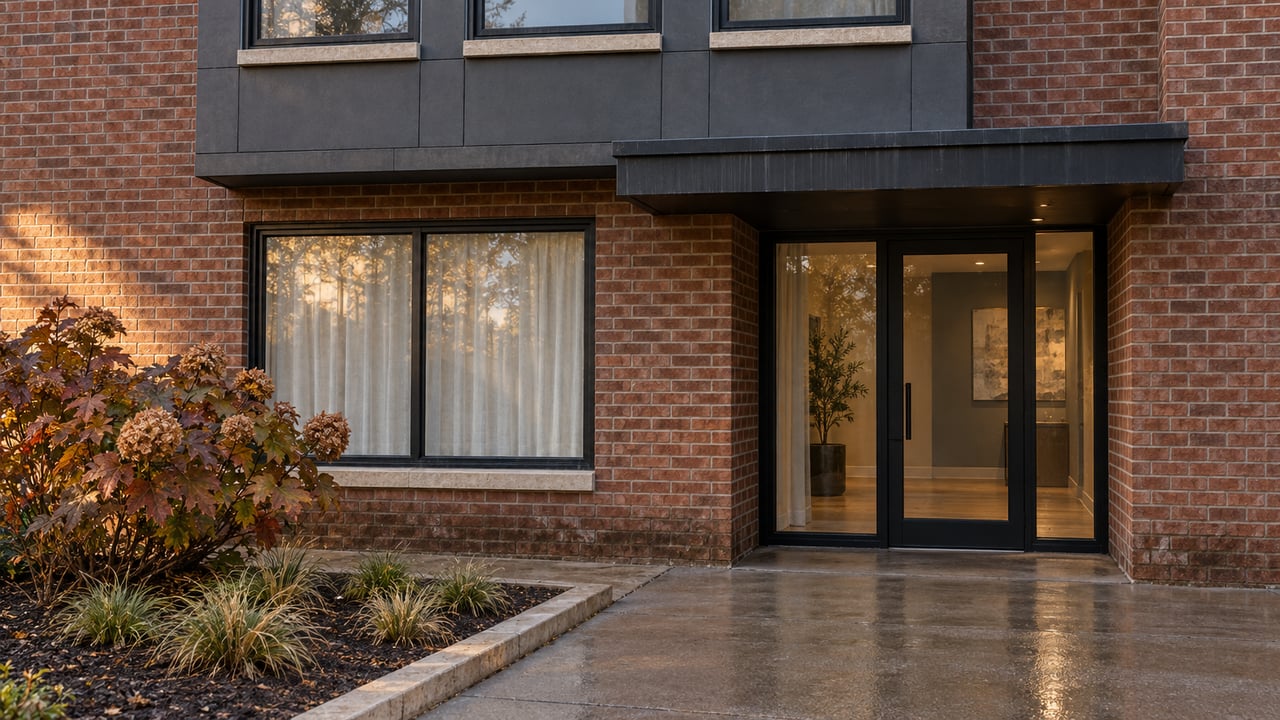
When you buy a condo in Royal Oak this fall, your lender looks at two things: your loan file and the association's budget, reserves and insurance policy. Under Fannie Mae rules that became mandatory in August, the second review got harder. More rules take effect on January 4, 2027. Meanwhile the city's own sales data shows condos and single-family houses pulling apart. Through September 2026, houses sold faster and for more money. Condos sold slower and for less.
Royal Oak's headline median looks steady. Underneath it, a buyer choosing a condo has a different negotiation, a different timeline and a different set of documents to read than a buyer choosing a bungalow a few blocks away.
Two Medians Moving in Opposite Directions
Realcomp's September 2026 Local Market Update for Royal Oak reports single-family homes and condos separately. The year-to-date figures through September 2026 rest on hundreds of closings, so they are the cleanest comparison:
| Royal Oak, Jan. through Sept. 2026 | Single-family residential | Condo |
|---|---|---|
| Median sale price | $383,050, up 3.5% | $240,000, down 4.9% |
| Median days on market | 24, up from 21 | 47, up from 38 |
| Percent of list price received | 100.4% | 96.9% |
| Closed sales | 704 | 165 |
| Months of supply, September | 2.8 | 5.0 |
The percent-of-list row shows the gap most plainly. If a condo is listed at $240,000, the difference between 96.9% and 100.4% of list comes to about $8,400 that the seller gives up and the buyer can negotiate. A typical house seller in Royal Oak this year has been getting asking price or a little more.
The single month of September makes the split look even wider. Royal Oak houses closed 73 sales in September 2026, up 14.1% from the year before, at a median of $384,000. Condos closed 12 sales, down 45.5%, at a median of $227,250, down 17.5%. Condo pending sales fell by half, from 20 to 10. Realcomp warns that small samples can make percentage changes look extreme, and 12 closings is a small sample. The year-to-date table is the better guide. Both views point the same way.
Condos Are Slow Everywhere. Royal Oak Is Where Prices Fell.
Countywide, condos are also the slower product. Through September 2026, Oakland County condos took a median of 39 days and sold at 98.3% of list. Single-family homes took 26 days at 99.8%. Countywide condo inventory rose 42.3% year over year to 1,060 units in September, while single-family inventory rose 20.4%.
Prices are a different story. The county's condo median rose 3.2% year to date to $289,000, a bit faster than the 2.5% gain for houses. Royal Oak's neighbors land in different places:
- Birmingham: the condo median rose 34.1% year to date to $399,000 on 71 closings. Condos still took 34 days against 24 for houses and sold at 97.6% of list against 98.8%. September condo supply was 8.8 months, compared with 4.1 for houses.
- Ferndale: the condo median fell 8.2% year to date to $286,750 while the single-family median rose 2.3%. Condos sold at 97.7% of list compared with 100.0% for houses.
- Royal Oak: the condo median is down 4.9% while houses are up 3.5%, and its condo listings sit longer than the county average.
Across this part of Oakland County, condos sell more slowly and below list. Royal Oak is the place where that slower pace has also shown up in price. If you're weighing a Royal Oak condo against a Birmingham condo or house, the two cities' condo numbers shouldn't be treated as the same kind of number.
What a Lender Reads Before It Reads Your File
A house is financed on the house. A condo is financed on the house and on the project it belongs to. Fannie Mae and Freddie Mac buy a large share of conventional mortgages, and both tightened their condo project standards in 2026.
Fannie Mae explained the reason in its Lender Letter LL-2026-03, dated March 18, 2026. It said it had seen a correlation between underfunded reserves and condo projects that need critical repairs, and that owners in those projects "can experience substantial financial hardship from unexpected special assessments or higher regular assessments or dues." The letter says the changes align with Freddie Mac. Its effective dates fall around this buying season:
- July 1, 2026. Master insurance policies must cover at least 100% of the estimated replacement cost of the project's improvements. The maximum per-unit deductible on a master policy is $50,000 for loan applications dated on or after this date.
- August 3, 2026. Fannie Mae's Limited Review is retired. Established projects now need a Full Review or, where eligible, a Waiver of Project Review. Lenders can no longer rely on a reserve study that uses "baseline funding," the method that lets reserves approach zero. When a reserve study is used, the association's budget must include the study's highest recommended allocation.
- January 4, 2027. For Full Review, the required replacement-reserve allocation rises from at least 10% to at least 15% of the association's annual budgeted assessment income.
Freddie Mac's Seller/Servicer Guide requires a project review and an eligibility determination for both new and established condo projects. It bars delivery of loans in projects rated Not Eligible. Its reserve section sets a floor of 10% of assessment income for replacement reserves, unless conditions for relying on a reserve study are met.
One change goes the other way and helps small buildings. Fannie Mae expanded its Waiver of Project Review to new and established projects with ten or fewer units. Projects of five to ten units qualify only if they aren't part of a master association or a larger development.
These reviews add steps to a condo deal that a house deal skips. In a building whose budget falls short of these thresholds, conventional financing is harder to get, which leaves fewer buyers who can make an offer.
Reserves and Insurance Drive the Monthly Cost
The association's finances set the monthly cost of owning a condo, and two items in those finances keep rising.
The first is insurance. A July 2026 post from a Michigan condominium law firm cites a national Community Associations Institute survey. Ninety-one percent of associations saw premium increases, and 17% saw increases of 100% or more. Twenty-three percent moved to surplus-lines carriers, and 20% lost access to at least one carrier. Those are national figures, not Michigan figures. A December 2025 Michigan Bar Journal article says a 2024 Michigan Supreme Court decision expanded associations' possible premises-liability exposure on common elements. The article advises boards to review their coverage.
The second is reserves. Michigan's Condominium Act, MCL 559.205, requires associations to keep a reserve fund for major repairs and replacement of common elements. It doesn't require a formal reserve study. House Bill 5784, introduced April 14, 2026, would require associations to do a reserve study and adopt a funding plan. It was referred to the Regulatory Reform Committee.
When a lender requires a 15% reserve allocation and the association has been budgeting 10%, the gap has to be made up somewhere. That usually means higher dues or a special assessment, which is the same outcome Fannie Mae described in its letter. Two condos with similar finishes can carry very different monthly costs, depending on whether their associations have already done this work.
Why New For-Sale Condos Are Rare on Main Street
In theory, new construction could refresh the condo supply with buildings that meet current lending and insurance rules. One recent project on North Main shows how small for-sale projects can turn into rentals instead.
At 1225 N. Main St., the site of an obsolete self-serve car wash, 1225 Flats LLC proposed ten townhomes with 15 parking spaces in a November 2025 submission to the Royal Oak Planning Commission. In a January 6, 2026 letter, Krieger Klatt Architects said the team had found no storm sewer in the alley or along Main. Routing stormwater toward Crooks would have meant rebuilding about 300 linear feet of public alley, at an estimated $450,000 to $500,000. The architects wrote that this cost "rendered the original building configuration infeasible." The redesigned project uses a connection toward Main estimated at $150,000 to $200,000. It has 12 one-bedroom apartments in place of a mix of one- and two-bedroom townhomes.
The Planning Commission recommended approval of the 12-unit plan on January 13, 2026. In April, the city's Brownfield Redevelopment Authority voted 5 to 0 to recommend a brownfield plan with eligible reimbursement capped at $513,348. The same January letter mentions a condominium under construction at Austin and Main. Most new housing in greater downtown Royal Oak is rental, though. Crain's Detroit Business reported in February 2025 that nearly 350 apartments were in the pipeline.
For a condo buyer, this means most choices are existing associations, with budgets and insurance policies written before the 2026 rules. Those documents now affect the deal as much as the unit's finishes do.
Questions That Set a Royal Oak Condo's Real Price
Use these to compare listings that look alike online:
- What share of the association's annual budget goes to replacement reserves, and how does it compare with the 10% and 15% thresholds above?
- Is there a recent reserve study, and does the budget fund its highest recommended allocation?
- What does the master insurance policy cover, and what is the per-unit deductible?
- Have dues or insurance premiums changed in the past two years, and are any special assessments approved or under discussion?
- Will the lender run a Full Review, or does the project qualify for a Waiver of Project Review?
The answers help explain why one Royal Oak condo sits at 47 days while a similar one goes under contract quickly. For the single-family side of the city, the Royal Oak neighborhood page and our guide to Royal Oak home styles describe the housing stock that is selling at 100.4% of list.
Quick Answers
Are Royal Oak condo prices falling? Through September 2026, the Royal Oak condo median was $240,000, down 4.9% year to date. The Oakland County condo median rose 3.2% over the same period.
Does the January 4, 2027 reserve rule apply to every condo loan? Fannie Mae's letter ties the 15% requirement to Full Review loan applications dated on or after January 4, 2027. Freddie Mac's guide sets its own reserve standards.
Is Royal Oak building new condos? A condominium was under construction at Austin and Main as of January 2026. The 1225 N. Main project changed from townhomes to apartments.
This post is general information, not legal, tax or financial advice. Lending, insurance and association rules depend on the specific project and loan, so confirm your situation with your lender, attorney or insurance professional.
If you're selling a Royal Oak condo, buyers will look at the association's documents as closely as the unit. Get those documents in order before you list, and show buyers that the building's finances are healthy from the start. Paul Wolfert and the Moving MI team can put together a free home valuation and customized marketing plan priced to the condo market as it stands now, not the citywide median.